Monday, June 2, 2014

American League All Star Game Selection

The All Star Game has become kind of a popularity contest allowing people to vote up to thirty times online. I think you should have one vote and vote for those who deserve to be in the game. The All Star Game is very important because the league that wins will have home field advantage in the World Series. People should vote for the best players in the league of their favorite teams. This way if their favorite team that team would have home field advantage. Below are my top two selections for each position in each league.

Joe Mauer is not performing well but should be picked to be in the All Star Game because it is in Minnesota this season. Also although Derek
Jeter leads the voting for AL shortstop, he is not playing very well, but this is his last season and should also be selected.
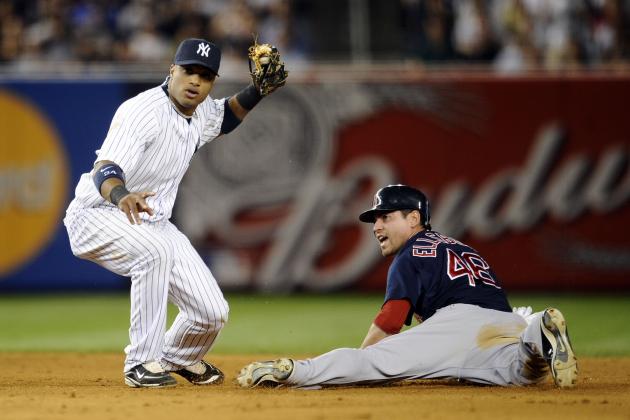
Robinson Cano

American League:

Catcher:
AJ Pierzynski - Boston Red Sox - .288/.317/.417
Kurt Suzuki - Minnesota Twins - .297/.
367/.399

First Base:
Edwin Encarnacion - Toronto Blue Jays - .279/.359/.615
Miguel Cabrera - Detroit Tigers - .325/.370/.558

Second Base: 
Robinson Cano - Seattle Mariners - .327/.371/.420 
Jose Altuve - Houston Astros - .318/.360/.429

Third Base: 
Josh Donaldson - Oakland Athletics - .284/.377/.550
Yangervis Solarte - New York Yankees - .294/.363/.458

Short Stop
Alexei Ramirez - Chicago White Sox - .327/.364/.477 
Derek Jeter - New York Yankees - .273/.337/.326

Outfield 1: 
Mike Trout - Los Angeles Angels - .294/.380/.549
Jose Bautista - Toronta Blue Jays .311/.441/.558

Outfield 2: 
Nelson Cruz
Michael Brantly - Cleveland Indians - .307/.370/.505
Shin-Soo Choo - Texas Rangers -.289/.414/.456

Outfield 3:
George Springer - Houston Astros .259/.444/.500 
Melky Cabrera - Toronto Blue Jays .308/.351/.497

Designated Hitter: 
Nelson Cruz - Baltimore Orioles - .314/.384/.672
Victor Martinez - Detroit Tigers -  .335/.390/.395

Fans do not get to choose the starting pitchers. That responsibility is given to the manager of each team. Usually the manager gives players on his team the benefit of the doubt and selects them to the All Star Game. 

Masahiro Tanaka and Yu Darvish
Starting Pitchers:
Masahiro Tanaka - New York Yankees - 2.06 ERA 88 k
Yu Darvish - Texas Rangers - 2.08 ERA 83 k
Mark Buehrle - Toronto Blue Jays - 2.10 ERA 46 k
Felix Hernandez - Seattle Mariners - 2.57 ERA 83 k
Sonny Grey - Oakland Athletics - 2.45 ERA 65 k 
James Shields - Kansas City Royals - 3.36 69 k

Relief Pitchers: 
Greg Holland - Kansas City Royals - 1.74 ERA 30 k 
Glen Perkins - Minnesota Twins  2.96 ERA 33 k
Koji Uehara - Boston Red Sox 0.76 ERA 34 k
Dellin Betances - New York Yankees 1.38 56 K
Sean Doolittle - Oakland Athletics 2.77 ERA 38 k

If you would like to cast your vote for the All Star Game follow this link. Vote Here. Remember to vote responsibly, this may make or break your favorite team. 

Sunday, June 1, 2014

Nippon to MLB ERA Index

Willie Mays and Masanori Murakami
Since 1995 33 Japanese pitchers have come to the MLB from the Nippon League. Some pitchers found much success and others have been complete failures. The first Japanese pitcher to pitch in the United States was Masanori Murakami who pitched two seasons with the San Francisco Giants in 1964 and 1965. The next Japanese pitcher would not pitch in the United States until Hideo Nomo in 1995.

The first three years for a Japanese pitcher in the MLB are the transition years. These years are the years that show what kind of pitcher he really is. The last three years in the Nippon League are basically what Major League Baseball teams look at when deciding to sign the pitcher. By compiling statistics from the last three years in the Nippon League and the first three years in the MLB one can make an accurate comparison on how the pitcher performed.

Hideo Nomo
There are a few pitchers who came to the MLB from Japan without ever pitching in the Nippon League, they will not be included in the statistics, because this only focuses on the transition from the Nippon League to the MLB. By finding the total number of innings pitched and earned runs allowed in the Nippon League by pitchers in their last three seasons, you can find the ERA of the average pitcher coming to the MLB in his last three seasons in the Nippon League. This ERA is 3.06. Then by doing the same thing, but for the first three years in the MLB the for the average Japanese pitcher is 3.90.

With the known statistics you can create a ratio to get an estimate or understanding of how the average Japanese pitcher would perform in the MLB after playing in the Nippon League. This is 3.90/3.06 which equates to 1.275. So by multiplying a pitcher's ERA over his last three seasons in the Nippon league by 1.275, you will have an estimate of his ERA in his first three seasons the MLB.

Takashi Saito
This does not work out perfectly for every pitcher because it is an average, it is supposed to just provide an estimate. Hideo Nomo had a 3.29 ERA in his last three seasons in the Nippon league but a 3.34 ERA in his first three seasons in the MLB, but it turns out to work wonderfully to project Nomo for his career ERA of 4.21.  Now Takashi Saito who had a 4.65 ERA in his last three season in the Nippon League and had a 1.95 ERA in his first three seasons in the MLB. He did significantly better. These are just two pitchers the transitional index does not work for. They are not average pitchers. Saito was not that good in his last three seasons in the Nippon League and Nomo was better than most in his lasts three seasons. Before Daisuke Matsuzaka 27 pitchers came to the MLB from the Nippon League and I bet most of you cannot name more than 8.

Daisuke Matsuzaka
Speaking of Matsuzaka, the Nippon to MLB index has changed dramatically since he has come to the MLB. Since Matsuzaka the only Japanese pitchers to come to the MLB from the Nippon League are Kuroda, Uehara, Darvish, Iwakuma, Fujikawa, and Tanaka. These are all what I call "Super Star" players. The pitchers before Matsuzaka were not "Super Star" players. These guys are the ones that absolutely dominate the league and expect
huge contracts from Major League teams. In their last three seasons in Nippon League their ERA is 2.26 and in their first three seasons in the MLB 3.37. Significantly less than the average Japanese pitcher coming from the Nippon League.  The ERA index for a "Super Star" pitcher is 1.5.

Yu Darvish in last three seasons in the Nippon League had a 1.71 ERA. That would mean he should have a 2.57 ERA in his first three seasons in the MLB. He has a 3.21 ERA through his first two and a third seasons.

Yu Darvish
Hisashi Iwakuma had a 2.87 ERA in his last three seasons in the Nippon League. That would mean he should have a 4.30 ERA in his first three MLB seasons, but he actually has a 2.87 ERA in his first two and third seasons.

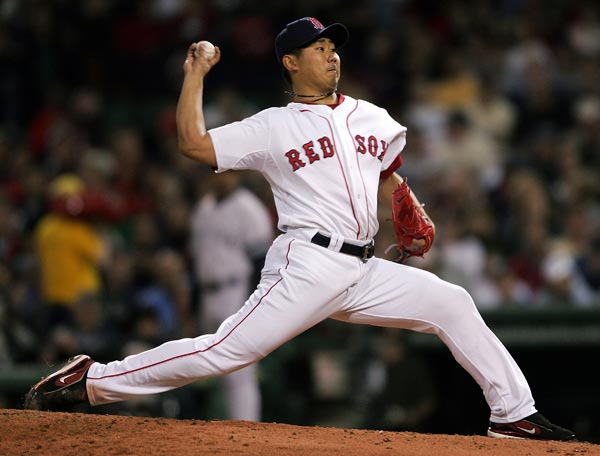
Masahiro Tanaka had a 1.44 ERA in his last three seasons in the Nippon League that means his ERA through his first three seasons in the MLB should be 2.16. In his first 11 games in the MLB he has a 2.06 ERA.

There are other pitchers you can see how they did and how they will do, but this basically tells us since Matsuzaka there has been less failure from Japanese pitchers coming from the Nippon League. If there is a "Super Star" pitcher in Japan meaning he has an ERA below 2.5 in Japan he is most certainly worth the money a team is willing to offer him. He should have an ERA from 3.18-3.75 which would mean an effective pitcher. If a pitcher has an ERA below 2.00 in the Nippon League he will have much success and little to no problems adjusting to the MLB.

Kenta Maeda
The next Japanese pitcher to come from the Nippon League to the MLB might be the right handed pitcher for the Hiroshima Carp, Kenta Maeda. He has a 2.05 ERA in his last three and a third seasons in the Nippon League. That means he should have a 2.61- 3.01 ERA in his first three seasons in the MLB. He is a "Super Star" pitcher. A few teams have heavily scouted him and he has expressed interest in playing in the Major Leagues.

 You can find a range for where the ERA of any Japanese pitcher in his first three seasons should fall by taking the average ERA of all Japanese pitchers and the average ERA of "Super Star" pitchers. So multiply the ERA in his last three seasons in the Nippon league by 1.275 and 1.5. The two numbers you get is an estimate of his ERA.


Wednesday, May 28, 2014

Trade Candidates

Starting Pitchers:

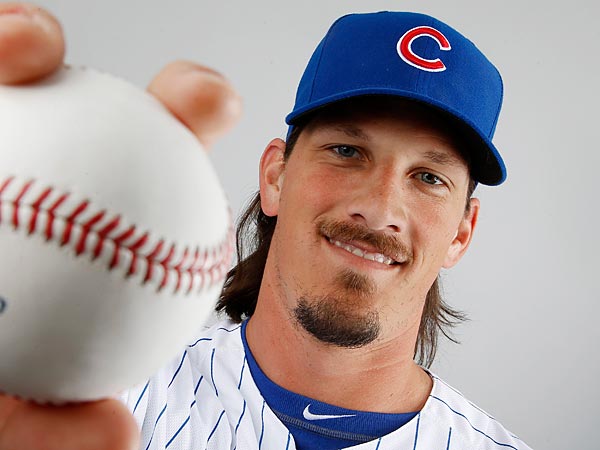
Jeff Samardzija has been pitching great this season and the Cubs have not been playing well. Losing teams are always prone to trade veteran players for prospects. Samardzija is pitching to a 1.68 ERA in 75 innings with 64 strikeouts. Possible suites for the 29 year old right hander  would be the Baltimore Orioles, the Toronto Blue Jays, the Los Angeles Angels, the New York Yankees, the Texas Rangers, and even the Colorado Rockies.

Jason Hammel is another steady Cubs pitcher who played with the Baltimore Orioles last year. Hammel is 31 years old and throughout his career he ranks as a 4th or 5th starter. In 2014 he is pitching to a 3.04 ERA in 64 innings with 54 strikeouts. Destinations for Hammel might include the Colorado Rockies, the Texas Rangers, the New York Yankees, or Los Angeles Angels.

Justin Masterson is not finding much success in 2014 and will be a free agent at the end of year. Masterson's ERA has risen up to 5.21 after his start last night, but he has the potential to be a number 1 or a really good number 2 starter. Masterson is 29 years old and if he wants to get a big pay day this off season he needs to improve, but for now he is a potential trade target for many teams. A team like the Boston Red Sox might be in on Masterson, somewhere he has played before.

David Price is without a doubt the biggest name being
bounced around in rumors. Price is pitching to a 4.42 ERA in 77 innings with 84 strikeouts. The ERA is bound to go down and Price is almost expected to be successful. The Rays traded James Shields two seasons ago for Wil Myers and Jake Ordizzi to the the Royals. Price may get an even bigger pay out that Shields. If Price is traded during the season the Texas Rangers, Atlanta Braves, Cincinnati Reds, and Arizona Diamondbacks seem like logical destinations for the hard throwing southpaw.

Relief Pitchers:

JJ Putz is nearing the end of his career and like all old relief pitchers the Yankees should be involved. Putz is on the DL now but he will be ready to go way before the trade deadline. He is 37 years old and has not had a bad season since 2009. The Baltimore Orioles, Pittsburgh Pirates, and Los Angeles Angels may also be in on the veteran.

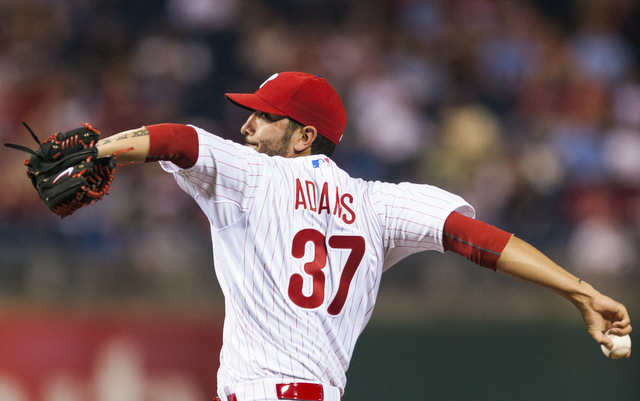
Mike Adams has been succesful for most of his career but now it appears he might change his team yet again. The crafty right handed pitcher has a 2.51 ERA this season and the Phillies are looking to get rid of some salary. The same teams who may be in on Putz should be in on Adams. Adams is 2 years younger than Putz at 35.

Infielders:

Alexei Ramirez has been raking for the White Sox with a .324/.357/.483 slashline and 9 stolen bases this season. He is a short stop by trade but can probably play second base easily. He is 32 years year old and will likely be a big addition this season.

Adam Dunn is a first baseman by trade, but projects more as a designated hitter. An American League team is likely to trade for Dunn if is he to be traded. Dunn has a .236/.391/.458 slashline this season which is pretty good for him in recent years. Dunn is 34 years old and can definitely provide power for any team.

Ruben Tejada has been the Mets' problem the past two seasons, but now they are trying to push him onto someone else. A team rebuilding may take a bid at Tejada, but the Mets won't get much in return for him. The Cubs, Phillies, White Sox, Astros, or Marlins may be potential landing spots for Tejada

Aaron Hill is 32 years old and has a .255/.314/.404 slashline this season. Hill is a second baseman, but can likely play third, although he has never done so in recent years. Hill would be a great addition for the Orioles,
Yankees, Braves, or Giants if Scutaro is not back by then.  

Chase Utley has been raking this year. He is a long shot to be traded but his .333/.389/.546 slashline is very appetizing to competing ball clubs. Chase Utley would likely to be dealt to the same teams Hill would be, but it is not likely in my eyes.

Outfielders:

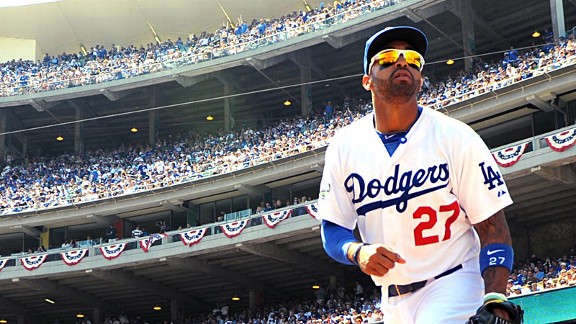
Matt Kemp: Matt Kemp is currently playing on the bench for the Dodgers and not providing much for the team. He has a .262/.325/.450 slashline in 43 games this season. Kemp is a super star with a heavy contract and one team that may be in on Kemp is the Boston Red Sox. The Red Sox though Jackie Bradley Jr. would fill the hole Ellsbury left, but they were wrong. Its time for the Red Sox to get the other end of the big trade they made in 2012. The Reds, Rangers, and Mariners might be other teams interested in the 29 year old outfielder.

Ichiro Suzuki is 40 years old, but still great on defense and still getting on base. The Yankees have too many outfielders and Ichiro wants to keep playing. A team that desperately needs an outfielder would trade for Ichiro, but it seems he will finish the year the the Yankees.

Alex Rios was traded from the White Sox to the Rangers not too long ago, but he would be a good trade candidate this off season. He is tearing it up with a .330/.361/.498 slashline this season, but he is 33 years old. Rios can play any outfield spot, but more of a corner outfielder. The Red Sox may go to Rios instead of Kemp, but the Giants, Nationals, or Mariners might be in on Rios.


Tuesday, May 27, 2014

Josh Beckett No Hits the Phillies

On Sunday May 25, Josh Beckett tossed his first career no hitter. Beckett has been stellar all year for the Los Angeles Dodgers, and no one expected him to be this good. In one report he has been using his curve ball a lot more and creating a lot of variation in the pitches he is throwing. Beckett has already surpassed the amount of innings he threw last year and his ERA is the lowest since his 2011 season at 2.43. In a rotation with names such as Kershaw, Greinke, Ryu, and Haren, I think we all find it surprising that Beckett is the second best. The two time World Series champ will look to find more success against the Pirates in his next start.

Saturday, April 12, 2014

A New Way To Look At Stolen Bases

Stealing a base at the Major League level is one of the hardest things to do in all of sports. In fact here is a video by Sports Science on how it breaks down: Base Stealing .  Stealing bases definitely has its pros because you get the extra base, but some people do not look at it in the right way. Think of a steal of second as turning a single into a double, and a steal of third as turning a double into a triple.

So players who steal a lot of bases often do not have such a high OPS+ mainly because of slugging percentages. Players who steal bases are historically known to be singles hitters. For example Juan Pierre is a career 84 OPS+ hitter, but has an average close to 50 steals a season. In 2012 Ben Revere stole 40 bases but had only an 89 OPS+.

Slugging percentage is calculated as total bases / total at bats. For total bases a single is worth one base, a double is worth two bases, a triple is worth three bases, and a home run is worth four bases. So if a stolen base practically turns a single into a double and a double into a triple then the stolen base should be accounted for in slugging percentage.

Before I elaborate, slugging percentage is often used to determine how well a player will drive in base runners. A player with a high slugging percentage will often hit doubles, triples, and home runs, hence driving in more runners. Additionally they will also get in scoring position better, because they do so from the get go. Slugging percentage has two practicalities.

So incorporating the stolen base into slugging percentage is very easy. Since a stolen base would be taking an additional base without an at bat, the number of at bats stay the same. The number of singles, doubles, triples, and home runs also stay the same. A stolen base would be worth one base and just added to the summation of bases.

One player I want to look at in particular is Jacoby Ellsbury. The Yankees got a lot of heat for signing Ellsbury instead of Robinson Cano. Ellsbury had 124 singles, 31 doubles, 8 triples, 9 home runs, and 52 stolen bases in 2013. He also had 577 at bats giving him a traditional slugging percentage of .426. Because he was caught stealing 4 times and theoretically speaking took away a base, his net stolen bases is what will be used to calculated his slugging percentage with his stolen bases. So Ellsbury's slugging percentage including stolen bases would be .515 ass opposed to .426, 89 points higher.

Robinson Cano's slugging percentage in 2013 was .516 and if you include his 6 net steals, .525. Robinson Cano was and still is a much better baseball player than Jacoby Ellsbury. Cano had a .383 on base percentage as opposed to Ellsbury's .355 on base percentage.  When accounting for stolen bases Cano's OPS was .908 in 2013 and Ellsbury's was .870. Ellsbury was just 38 points behind Cano, statistically speaking that is not very much.

To understand how important the stolen base is to Ellsbury in this particular case Prince Fielder had 32, 38, and 30 home runs and .471, .566, and .528 slugging percentages from 2010-2012 respectively. He did have an on base percentage over .400 each one of those years, but his average .521 slugging percentage is almost exactly Ellsbury's .505 career slugging percentage.Stolen bases are just as important as home runs.

To have some fun with this in 2012 Mike Trout stole 49 bases raising his slugging percentage from .564 to .642.  Miguel Cabrera had a .606 slugging percentage with just 3 net steals. Mike Trout's on base percentage was .399 and Miguel Cabrera's was .393. Giving Mike Trout a 1.041 OPS and Miguel Cabrera a .999 OPS+. They are practically identical, but Trout was stellar on defense and used his speed in additional ways, but Miguel Cabrera won the triple crown in 2012 and won the MVP on the historical basis.

FUN WITH NUMBERS!

Saturday, April 5, 2014

Masahiro Tanaka's First Start

Possibly the biggest story of the off season and spring training was Japanese phenom Masahiro Tanaka. After a dominating spring training and a long journey from his home country, Tanaka made his first start for the New York Yankees.

The $155 Million man. 
Tanaka's first start was against the Toronto Blue Jays on Friday night, and he was welcomed by the first batter he faced, Melky Cabrera, who hit a home run. After that home run he did get Colby Rasmus to gound out and proceeded to strike out Jose Bautista and Edwin Encarnacion. Tanaka made Bautista and Encarnacion look silly in these two at bats. Encarnacion would later get two hits off of Tanaka, but Bautista would be held hitless.

Although he never reached 100 pitches Tanaka was pulled after 7 innings allowing just 2 earned runs on 6 hits. He faced one of the best lineups in the American League on Friday and he proved to many what he could do. Tanaka did not get rattled after the home run, he kept his composure and proceeded to pitch a great game. His next start will be against another great lineup, the Baltimore Orioles, at Yankee Stadium.

Tuesday, April 1, 2014

Big Seasons in 2014

Some players flat out had a terrible 2013 season, others made progress towards becoming better players, and some took a decline. Here are some names that I predict will have great 2014 seasons.

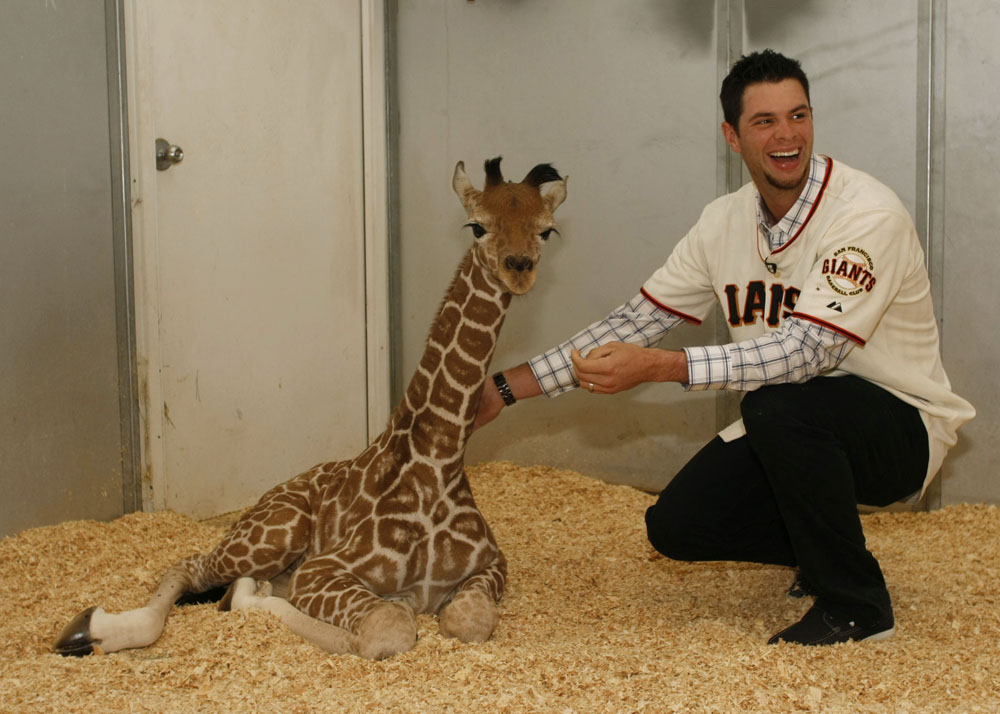
I have no idea why Belt is petting a baby Giraffe 
Brandon Belt

Brandon Belt is entering his age 26 season and has shown that he has patience at the plate. In 2012 and 2013 he had a .360 on base percentage, with his batting average rising from .275 to .289. Belt finally has a secure spot in the Giants lineup and is a much needed part of their offense. Belt showed much more power in 2013 hitting 17 home runs instead of 7 the year previous and 39 doubles instead of 27 the previous year. You can expect Belt to get on base, hit more home runs, and drive in plenty of runs, making 2014 his best year yet.

Justin Masterson

Justin Masterson is going to be a free agent at the end of 2014 season, and historically players preform pretty well in the final year of their contract. Masterson had the second best season of his career in 2013 posting a 3.45 ERA in 193 innings pitched, striking out 195. His best season was 2011 where he had a 3.21 ERA in 216 innings pitched with 158 strikeouts. In 2012 Masterson took a step back and posted a 4.93 ERA, but 2014 will be different. In 2013 we saw a significant decline in hits allowed, previous to 2013 Masterson allowed an average of 207 hits a season, in 2013 he allowed just 156. Previous to 2013 Masterson struck out just an average of 152 per season, and in 2013 he struck out 195. Masterson is a ground ball pitcher striking guys out, he is heading a very good direction and a very big pay day.

Josh Hamilton

Josh Hamilton signed a mega deal with the Los Angeles Angels and did not perform as expected in the first year of the contract. Hamilton had his worst season since 2009 posting a 108 OPS+ although he did play 151 games, hit 21 home runs, and drove in 29 RBIs. We all know the ball does not carry as well in Los Angeles as it does in Texas, but Hamilton has serious power. I think the first year in LA was just Hamilton adjusting. He came into spring training of 2013 lighter, because in Texas he would lose weight quickly throughout the season. Now that he understands what will occur throughout the season in Los Angeles and the fact that it is also very hot in LA, Hamilton will have a great 2014 season.

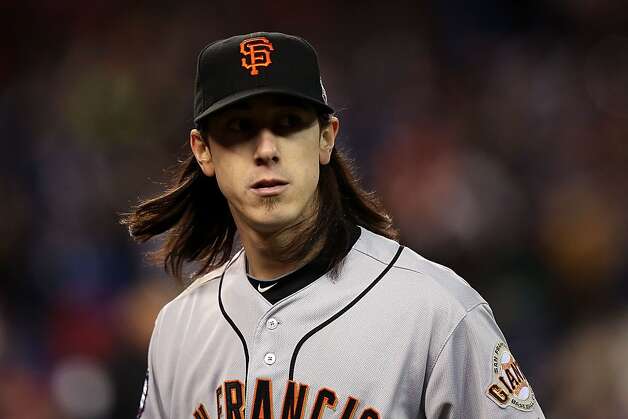
Coincidentally Lincecum started to do better since he
cut his hair in 2013. 
Tim Lincecum

It seems like I say this every year, but Lincecum has not performed worse than the season before. In 2012 Lincecum had the worst season of his career posting a 5.18 ERA. In 2013 Lincecum dropped his ERA to 4.37. This is similar to the 2010-2011 season drop in ERA Lincecum experienced. In 2010 Lincecum's ERA was at a career high 3.43, in 2011 his ERA dropped 69 points to 2.74. Lincecum started throwing much earlier this off season in a warehouse in Seattle, so he is ready for the season. He said he is just concentrating on getting outs, not strikeouts. You will see a drop in ERA once again. We will probably never see the Lincecum of old again, but you will see a highly effective pitcher. I'm predicting a 75 point drop in ERA and a 3.62 ERA for Lincecum in 2014.