Showing posts with label MLB. Show all posts

Sunday, June 1, 2014

Nippon to MLB ERA Index

Willie Mays and Masanori Murakami
Since 1995 33 Japanese pitchers have come to the MLB from the Nippon League. Some pitchers found much success and others have been complete failures. The first Japanese pitcher to pitch in the United States was Masanori Murakami who pitched two seasons with the San Francisco Giants in 1964 and 1965. The next Japanese pitcher would not pitch in the United States until Hideo Nomo in 1995.

The first three years for a Japanese pitcher in the MLB are the transition years. These years are the years that show what kind of pitcher he really is. The last three years in the Nippon League are basically what Major League Baseball teams look at when deciding to sign the pitcher. By compiling statistics from the last three years in the Nippon League and the first three years in the MLB one can make an accurate comparison on how the pitcher performed.

Hideo Nomo
There are a few pitchers who came to the MLB from Japan without ever pitching in the Nippon League, they will not be included in the statistics, because this only focuses on the transition from the Nippon League to the MLB. By finding the total number of innings pitched and earned runs allowed in the Nippon League by pitchers in their last three seasons, you can find the ERA of the average pitcher coming to the MLB in his last three seasons in the Nippon League. This ERA is 3.06. Then by doing the same thing, but for the first three years in the MLB the for the average Japanese pitcher is 3.90.

With the known statistics you can create a ratio to get an estimate or understanding of how the average Japanese pitcher would perform in the MLB after playing in the Nippon League. This is 3.90/3.06 which equates to 1.275. So by multiplying a pitcher's ERA over his last three seasons in the Nippon league by 1.275, you will have an estimate of his ERA in his first three seasons the MLB.

Takashi Saito
This does not work out perfectly for every pitcher because it is an average, it is supposed to just provide an estimate. Hideo Nomo had a 3.29 ERA in his last three seasons in the Nippon league but a 3.34 ERA in his first three seasons in the MLB, but it turns out to work wonderfully to project Nomo for his career ERA of 4.21.  Now Takashi Saito who had a 4.65 ERA in his last three season in the Nippon League and had a 1.95 ERA in his first three seasons in the MLB. He did significantly better. These are just two pitchers the transitional index does not work for. They are not average pitchers. Saito was not that good in his last three seasons in the Nippon League and Nomo was better than most in his lasts three seasons. Before Daisuke Matsuzaka 27 pitchers came to the MLB from the Nippon League and I bet most of you cannot name more than 8.

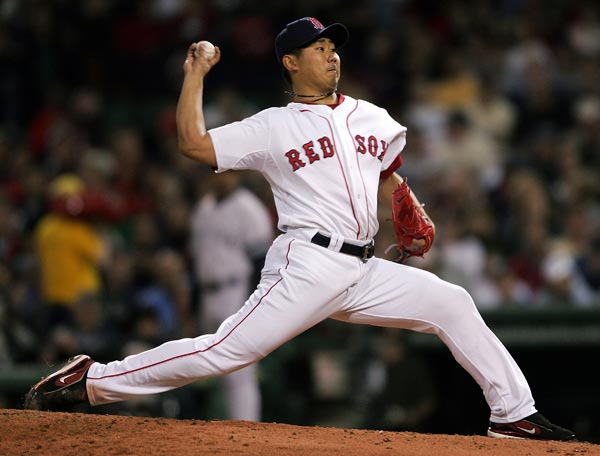
Daisuke Matsuzaka
Speaking of Matsuzaka, the Nippon to MLB index has changed dramatically since he has come to the MLB. Since Matsuzaka the only Japanese pitchers to come to the MLB from the Nippon League are Kuroda, Uehara, Darvish, Iwakuma, Fujikawa, and Tanaka. These are all what I call "Super Star" players. The pitchers before Matsuzaka were not "Super Star" players. These guys are the ones that absolutely dominate the league and expect
huge contracts from Major League teams. In their last three seasons in Nippon League their ERA is 2.26 and in their first three seasons in the MLB 3.37. Significantly less than the average Japanese pitcher coming from the Nippon League.  The ERA index for a "Super Star" pitcher is 1.5.

Yu Darvish in last three seasons in the Nippon League had a 1.71 ERA. That would mean he should have a 2.57 ERA in his first three seasons in the MLB. He has a 3.21 ERA through his first two and a third seasons.

Yu Darvish
Hisashi Iwakuma had a 2.87 ERA in his last three seasons in the Nippon League. That would mean he should have a 4.30 ERA in his first three MLB seasons, but he actually has a 2.87 ERA in his first two and third seasons.

Masahiro Tanaka had a 1.44 ERA in his last three seasons in the Nippon League that means his ERA through his first three seasons in the MLB should be 2.16. In his first 11 games in the MLB he has a 2.06 ERA.

There are other pitchers you can see how they did and how they will do, but this basically tells us since Matsuzaka there has been less failure from Japanese pitchers coming from the Nippon League. If there is a "Super Star" pitcher in Japan meaning he has an ERA below 2.5 in Japan he is most certainly worth the money a team is willing to offer him. He should have an ERA from 3.18-3.75 which would mean an effective pitcher. If a pitcher has an ERA below 2.00 in the Nippon League he will have much success and little to no problems adjusting to the MLB.

Kenta Maeda
The next Japanese pitcher to come from the Nippon League to the MLB might be the right handed pitcher for the Hiroshima Carp, Kenta Maeda. He has a 2.05 ERA in his last three and a third seasons in the Nippon League. That means he should have a 2.61- 3.01 ERA in his first three seasons in the MLB. He is a "Super Star" pitcher. A few teams have heavily scouted him and he has expressed interest in playing in the Major Leagues.

 You can find a range for where the ERA of any Japanese pitcher in his first three seasons should fall by taking the average ERA of all Japanese pitchers and the average ERA of "Super Star" pitchers. So multiply the ERA in his last three seasons in the Nippon league by 1.275 and 1.5. The two numbers you get is an estimate of his ERA.


Saturday, January 21, 2012

5 Players to Have a Big 2012 Season

Looking at various statistics, there are a few players I believe will have a breakthrough or comeback seasons in 2012.

Robinson Cano - Cano is entering his age 29 season. Players are said to be in their prime from the ages of 28-32. 2011 for Robinson Cano was a down year from 2009 and 2010. He plays about 160 games a year, I think 2012 wont be any different. He is a doubles machine getting an average of 45 doubles a year over the past 3 years. His power serge gives him an average of 27 home runs a year over the past 3 years. Also averaging 104 RBI's over the past 3 years. I project Cano to finish with 30 home runs 120 RBI's and a .370 on base percentage.

Prince Fielder - Fielder will be 28 in May of 2012 and he already has established the title of a super slugger. With an average OPS of .955 over his past 3 seasons he is without a doubt a power house. Depending on where he signs that number could skyrocket. If he signs with The Rangers or The Orioles or any team in a hitter friendly park he can put up some big numbers. I project Fielder to finish with 40 home runs 115 RBI's and a .400 on base percentage no matter where he plays.

Albert Pujols - After 2011 the 32 year old Pujols looked to be on the decline. I think that a change of scenery will bring him back to the Pujols of old. Pujols has always been known to get on base and draw walks. With a new offense in front of him he may have an another big season. playing 13 few games than usual Pujols hit 37 home runs in 2011. Playing against American League pitching I say he finishes with 42 home runs, 120 RBI's and a .390 on base percentage.

Tim Lincecum - The Freak will turn 28 in June of 2012 After an improved 2011 season. 2010 was disappointing for Lincecum although The Giants won the world series. A 0.69 point drop in ERA from 2010 to 2011 means Lincecum is going back to being himself. Although his strike outs have been declining, his whip remains the same. I see a spike in his strikeouts to occur in 2012 giving him a 2.65 ERA, 240 strikeouts, 1.1 WHIP and of course 200+ inning pitched.

Yu Darvish - Darvish will be 26 in Mid season of 2012. In Japan he had a 1.72 ERA over 5 years and an average of 217 strikeouts a year. The only thing I am frightened about is that he only pitches about 26 games a season. How will he perform in September and October. Japanese pitchers tend to have their best season in the first year in the MLB. I project Darvish to finish with a 2.78 ERA, 210 strikeouts, 1.0 WHIP and slightly over 200 innings pitched.

Sunday, January 8, 2012

If Only I Was the Angles' GM.

The Angles just extended Howie Kendrick's contract. They also signed CJ Wilson and Albert Pujols. They have the best pitching rotation in the MLB with Weaver, Haren, Wilson, and Santana and the best first baseman and hitter of the past 10 years. They have it pretty good. The Angels also have Trumbo and Morales left over, what will they do with them.

If I were the Angels' general manager I would bring up a trade. This trade would involve Morales, Aybar, Chatwood, and the team's choice of $2 million or another prospect. But now the team for these players to be traded to... The Miami Marlins. Can you guess who? Hanley Ramirez.

Hanley Ramirez is an all star and capable of outstanding numbers. With the recent acquisition of Jose Reyes, the Marlins say Hanley will be moving to third base, which Ramirez is not fond of.  Perhaps a change of scenery would be nice.

The Marlins were in on Albert Pujols, but of course he went to the Angels. The Marlins aren't in on Fielder because he wont bring what Pujols would have to the Latino community. Morales has been injured for 2011 because of the incident when he hit a walk off home run and hurt his leg when celebrating. But he is healthy now and is capable of outstanding hitting. He is also of Latin origins and will bring a lot to the Latino community.

In this trade Aybar will be traded to the Marlins to replace Ramirez at third. This is a logical choice, because the Angels would no longer need a shortstop, because they have Ramirez. Also Aybar has remarkable speed, which is a big part of Marlins' offense.

Chatwood is young and could round out the rotation for the Marlins. Pitiching in the National League will maybe lower his ERA. Johnson, Burhlie,  Zambrano, Chatwood, is a pretty decent pitching rotation. The Angels don't need Chatwood. because they have the previously mentioned pitching rotation all in their prime.

Finally the Angels and Marlins will decide weather the Angels will take 0, 25, 50, 75, or 100 percent of Ramirez's contract. The choice of $2 million or a prospect will remain, but Andrew Romine will not be an option, becuase he is the back up plan if Ramirez is a fluke. Ramirez only played around 90 games in 2011 which would make some skeptical, but I believe the Marlins will take it as yet another reason to trade him.

Tuesday, November 22, 2011

The Upcoming Seasons. 2012 & 2013

I don't know exactly how I feel about the changes to occur in the upcoming seasons. The Astros are going to the American League West and there will be 2 wildcard spots for the playoffs per league.

Now there will be 5 teams in each division and each team will have an equal chance to win a playoff spot. But now every team will not play on the same day except during interleague play. If there are 15 teams and each team plays each other, one team will not be playing at all times. If opening day series is 3 games, then would one team play 3 days later?

The wildcard addition was a good idea. The two wildcard teams will play each other in a playoff round in a series of 3 or 5 games. The winner will move onto the alds.

I think baseball should make a 176 game season. To begin one week early and end one week later. Also scheduled double headeders should be scheduled on every Sunday and a scheduled off day every Monday. This will make room for make up games, give rookies and bench players a chance to play, and rest players efficiently.