|
| Willie Mays and Masanori Murakami |
Since 1995 33 Japanese pitchers have come to the MLB from the Nippon League. Some pitchers found much success and others have been complete failures. The first Japanese pitcher to pitch in the United States was Masanori Murakami who pitched two seasons with the San Francisco Giants in 1964 and 1965. The next Japanese pitcher would not pitch in the United States until Hideo Nomo in 1995.
The first three years for a Japanese pitcher in the MLB are the transition years. These years are the years that show what kind of pitcher he really is. The last three years in the Nippon League are basically what Major League Baseball teams look at when deciding to sign the pitcher. By compiling statistics from the last three years in the Nippon League and the first three years in the MLB one can make an accurate comparison on how the pitcher performed.
 |
| Hideo Nomo |
There are a few pitchers who came to the MLB from Japan without ever pitching in the Nippon League, they will not be included in the statistics, because this only focuses on the transition from the Nippon League to the MLB. By finding the total number of innings pitched and earned runs allowed in the Nippon League by pitchers in their last three seasons, you can find the ERA of the average pitcher coming to the MLB in his last three seasons in the Nippon League. This ERA is 3.06. Then by doing the same thing, but for the first three years in the MLB the for the average Japanese pitcher is 3.90.
With the known statistics you can create a ratio to get an estimate or understanding of how the average Japanese pitcher would perform in the MLB after playing in the Nippon League. This is 3.90/3.06 which equates to 1.275. So by multiplying a pitcher's ERA over his last three seasons in the Nippon league by 1.275, you will have an estimate of his ERA in his first three seasons the MLB.
 |
| Takashi Saito |
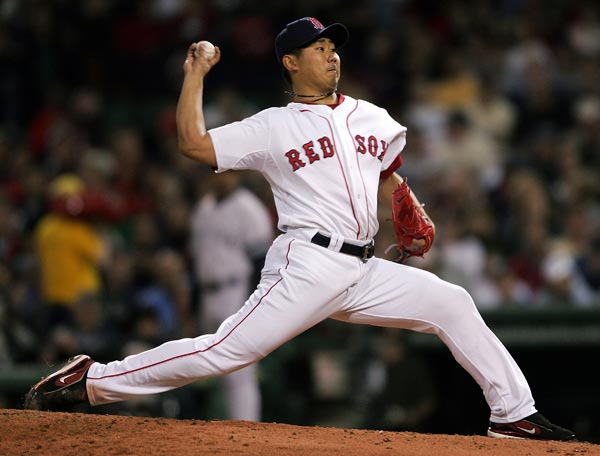
This does not work out perfectly for every pitcher because it is an average, it is supposed to just provide an estimate. Hideo Nomo had a 3.29 ERA in his last three seasons in the Nippon league but a 3.34 ERA in his first three seasons in the MLB, but it turns out to work wonderfully to project Nomo for his career ERA of 4.21. Now Takashi Saito who had a 4.65 ERA in his last three season in the Nippon League and had a 1.95 ERA in his first three seasons in the MLB. He did significantly better. These are just two pitchers the transitional index does not work for. They are not average pitchers. Saito was not that good in his last three seasons in the Nippon League and Nomo was better than most in his lasts three seasons. Before Daisuke Matsuzaka 27 pitchers came to the MLB from the Nippon League and I bet most of you cannot name more than 8.
 |
| Daisuke Matsuzaka |
Speaking of Matsuzaka, the Nippon to MLB index has changed dramatically since he has come to the MLB. Since Matsuzaka the only Japanese pitchers to come to the MLB from the Nippon League are Kuroda, Uehara, Darvish, Iwakuma, Fujikawa, and Tanaka. These are all what I call "Super Star" players. The pitchers before Matsuzaka were not "Super Star" players. These guys are the ones that absolutely dominate the league and expect
huge contracts from Major League teams. In their last three seasons in Nippon League their ERA is 2.26 and in their first three seasons in the MLB 3.37. Significantly less than the average Japanese pitcher coming from the Nippon League. The ERA index for a "Super Star" pitcher is 1.5.
Yu Darvish in last three seasons in the Nippon League had a 1.71 ERA. That would mean he should have a 2.57 ERA in his first three seasons in the MLB. He has a 3.21 ERA through his first two and a third seasons.
 |
| Yu Darvish |
Hisashi Iwakuma had a 2.87 ERA in his last three seasons in the Nippon League. That would mean he should have a 4.30 ERA in his first three MLB seasons, but he actually has a 2.87 ERA in his first two and third seasons.
Masahiro Tanaka had a 1.44 ERA in his last three seasons in the Nippon League that means his ERA through his first three seasons in the MLB should be 2.16. In his first 11 games in the MLB he has a 2.06 ERA.
There are other pitchers you can see how they did and how they will do, but this basically tells us since Matsuzaka there has been less failure from Japanese pitchers coming from the Nippon League. If there is a "Super Star" pitcher in Japan meaning he has an ERA below 2.5 in Japan he is most certainly worth the money a team is willing to offer him. He should have an ERA from 3.18-3.75 which would mean an effective pitcher. If a pitcher has an ERA below 2.00 in the Nippon League he will have much success and little to no problems adjusting to the MLB.
 |
| Kenta Maeda |
The next Japanese pitcher to come from the Nippon League to the MLB might be the right handed pitcher for the Hiroshima Carp, Kenta Maeda. He has a 2.05 ERA in his last three and a third seasons in the Nippon League. That means he should have a 2.61- 3.01 ERA in his first three seasons in the MLB. He is a "Super Star" pitcher. A few teams have heavily scouted him and he has expressed interest in playing in the Major Leagues.
You can find a range for where the ERA of any Japanese pitcher in his first three seasons should fall by taking the average ERA of all Japanese pitchers and the average ERA of "Super Star" pitchers. So multiply the ERA in his last three seasons in the Nippon league by 1.275 and 1.5. The two numbers you get is an estimate of his ERA.