Showing posts with label Ellsbury. Show all posts

Thursday, May 19, 2016

The Statistical Theory Behind the Shift

The Cardinals Executing the Shift
For years now Major League teams have been implementing "The Shift". The shift is a strategic re-positioning of fielders according to where a batter hits the ball most often. A shift for a left handed hitter will traditionally have the short stop play right up the middle, the second baseman play about two-thirds of the way between first and second base, the first baseman close to the line, and the third baseman play in shallow right field, with all the outfielders shading toward right field.


Why do teams shift?

Through years of compiling detailed data about players' batted balls teams were able to come to the conclusion that the traditional positioning of fielders may be inefficient for certain players. These teams observed that some players hit to one particular field more than others. The mistake that teams were making for decades was assuming a uniform distribution of hits. This means that team was assuming that when a player hit a ball, that ball had an equal probability of landing anywhere on the field. When teams discovered that the hitting distribution was not uniform, and in fact skewed, they adjusted their fielders accordingly.

The Mathematics Behind The Shift

Through any analytical process there are always numbers backing up the claim. In fact not many people will accept you claim with out any mathematical or statistical backing. The mathematics that support the shift is something called the sum of squares residuals. A residual is the difference between an observed value and the expected value. For example Derek Jeter's career batting average before his last season was .312. So the expected value for his batting average in his last season was .312. He ended up hitting for a batting average of .256 in his final season, so the residual would be (.256 - .312) which equals -0.056. For predictive models you want to minimize the sum of squares residuals, if your sum of squares residuals is equal to zero, the predictive model would be the most efficient.  By predicting where the ball may land, the shift will minimize the distance a player will have to run to get the ball. In this case the observed value is the distance a player will have to run, and the expected value is zero. The claim is that by shifting the sum of the distance needed to be covered by a fielder is minimized.

Example of the Effectiveness of The Shift

Lets compare two players, Jacoby Ellsbury and Chris Davis in 2015. Jacoby Ellsbury had a hit distribution that was close to uniform. He hit to right field at a rate of 37.8%, to center field at a rate of 35.1%, and to left field at a rate of 27.0%. Teams typically play Ellbsury straight up, the traditional positioning of the fielders. A uniform hit distribution would have about 33.3% to all fields, so you can see that Ellsbury's hit distribution is a bit skewed. So in theory a defense should shift slightly toward right field for Ellsbury. Chris Davis on the other hand hit to right field at a rate of 55.9%, center field at a rate of 26.5%, and to left field at a rate of 17.6%. Davis' hit distribution is very skewed to right field. So theoretically you would want to position your players closer to right field than the traditional way.

The Shift: Visual Example

For this example imagine a left handed pull hitter, such as Chris Davis. The first diagram is a traditional positioning for a defense and on the second diagram is the shifted positioning for a defense. The red dots are where a ball landed and the black lines are the distance the fielder had to run to get the ball.

Notice that the distances the fielders had to run are 10 ft, 5 ft, and 15 ft. The expected value that the fielders had to run was 0 ft. So the residuals would be:
10 - 0 = 10
5 - 0 = 5
15 -0 = 15
And the sum of these values squared is:
10^2 + 5^2 + 15^2 = 350.


In this diagram the red dot are in the exact same location, but the defense is shifted toward right field. Notice that the distance the fielders had to run is much smaller. The residuals would be:
10 - 0 = 10
2 - 0 = 2
1- 0 = 1
And the sum of these values squared is:
10^2 + 2^2 + 1^2 = 105

The sum of squared residuals is much smaller for the shifted defense than it is for the traditional defense.


Conclusions 

The shift is here to stay. Physically players hit the ball the furthest when they pull the ball, so a big guy like Chris Davis will try to pull the ball to try to hit a home run. This trade off is something that Davis can live with a player. Since 2012 Chris Davis has averaged 40 home runs per season, but has only a .256 batting average. He has made a decision as a player that he would rather produce power numbers rather than hitting safely more often. There are situations that it would make logical sense to hit a ground ball toward the left side of the field for a hit; such as in a close game in the 9th inning, but Davis has the potential to hit the ball out of the ballpark.

Every player in the MLB is different and that calls for a different shift for each player. It is up to the analytic department to keep up on that and determine the best shift for a player and they do that by determining the minimal sum of square residuals.

Saturday, April 12, 2014

A New Way To Look At Stolen Bases

Stealing a base at the Major League level is one of the hardest things to do in all of sports. In fact here is a video by Sports Science on how it breaks down: Base Stealing .  Stealing bases definitely has its pros because you get the extra base, but some people do not look at it in the right way. Think of a steal of second as turning a single into a double, and a steal of third as turning a double into a triple.

So players who steal a lot of bases often do not have such a high OPS+ mainly because of slugging percentages. Players who steal bases are historically known to be singles hitters. For example Juan Pierre is a career 84 OPS+ hitter, but has an average close to 50 steals a season. In 2012 Ben Revere stole 40 bases but had only an 89 OPS+.

Slugging percentage is calculated as total bases / total at bats. For total bases a single is worth one base, a double is worth two bases, a triple is worth three bases, and a home run is worth four bases. So if a stolen base practically turns a single into a double and a double into a triple then the stolen base should be accounted for in slugging percentage.

Before I elaborate, slugging percentage is often used to determine how well a player will drive in base runners. A player with a high slugging percentage will often hit doubles, triples, and home runs, hence driving in more runners. Additionally they will also get in scoring position better, because they do so from the get go. Slugging percentage has two practicalities.

So incorporating the stolen base into slugging percentage is very easy. Since a stolen base would be taking an additional base without an at bat, the number of at bats stay the same. The number of singles, doubles, triples, and home runs also stay the same. A stolen base would be worth one base and just added to the summation of bases.

One player I want to look at in particular is Jacoby Ellsbury. The Yankees got a lot of heat for signing Ellsbury instead of Robinson Cano. Ellsbury had 124 singles, 31 doubles, 8 triples, 9 home runs, and 52 stolen bases in 2013. He also had 577 at bats giving him a traditional slugging percentage of .426. Because he was caught stealing 4 times and theoretically speaking took away a base, his net stolen bases is what will be used to calculated his slugging percentage with his stolen bases. So Ellsbury's slugging percentage including stolen bases would be .515 ass opposed to .426, 89 points higher.

Robinson Cano's slugging percentage in 2013 was .516 and if you include his 6 net steals, .525. Robinson Cano was and still is a much better baseball player than Jacoby Ellsbury. Cano had a .383 on base percentage as opposed to Ellsbury's .355 on base percentage.  When accounting for stolen bases Cano's OPS was .908 in 2013 and Ellsbury's was .870. Ellsbury was just 38 points behind Cano, statistically speaking that is not very much.

To understand how important the stolen base is to Ellsbury in this particular case Prince Fielder had 32, 38, and 30 home runs and .471, .566, and .528 slugging percentages from 2010-2012 respectively. He did have an on base percentage over .400 each one of those years, but his average .521 slugging percentage is almost exactly Ellsbury's .505 career slugging percentage.Stolen bases are just as important as home runs.

To have some fun with this in 2012 Mike Trout stole 49 bases raising his slugging percentage from .564 to .642.  Miguel Cabrera had a .606 slugging percentage with just 3 net steals. Mike Trout's on base percentage was .399 and Miguel Cabrera's was .393. Giving Mike Trout a 1.041 OPS and Miguel Cabrera a .999 OPS+. They are practically identical, but Trout was stellar on defense and used his speed in additional ways, but Miguel Cabrera won the triple crown in 2012 and won the MVP on the historical basis.

FUN WITH NUMBERS!

Wednesday, December 4, 2013

Ellsbury, Morneau, Saltalamacchia Sign. Fowler, Gentry, Lindblom, Bell, Smith Gregerson Traded

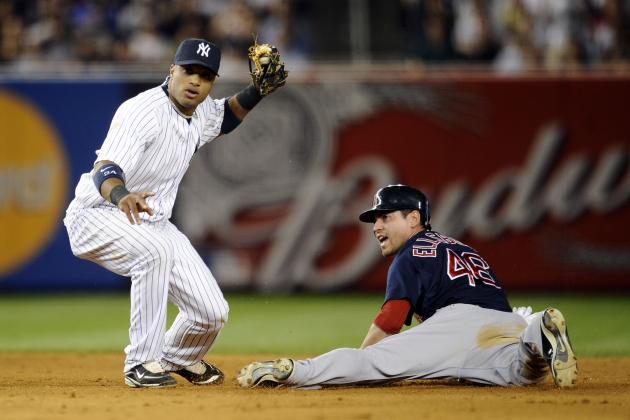
Jacoby Ellsbury in his new uniform
The biggest news of yesterday's busy day was the signing of Jacoby Ellsbury. The New York Yankees signed the All Star Jacoby Ellsbury to a colossal 7 year $148 Million deal. Ellsbury will join an outfield with Brett Gardner and Ichiro Suzuki probably making the best defensive outfield in the MLB. Ellsbury has had some fluctuation in his stats from year to year, but he has been someone consistent. He has put up a .297/.350/.439 slashline for his career, and has one dominating season under his belt. Ellsbury has led the league in stolen bases 3 seasons and has a 162 game average of 55 stolen bases. With an average annual war of 3.9 and assigning $5 Million to each win above replacement Ellsbury seems to be worth the deal. Johnny Damon is a similar player to make the transition from the Red Sox to the Yankkes via free agency, and he saw some success. Damon's average home run totals increased from 14 to 19.25 per season. That is a 37.5% increase. If the same can be said for Ellsbury, who has an average home run total of 15 home runs per season, you can expect him to hit about 20 home runs a year in Yankee Stadium. Combined with his speed and defense, Ellsbury will be an impact player for the Yankees, although his signing most likely takes them out of competition for Cano.

Justin Morneau
In the wake of Todd Helton's retirement the Rockies signed slugging first baseman Justin Morneau to a 2 year $13 Million deal. Morneau was traded to the Pirates mid season and was a big help for getting them to the post season. He hit 17 home runs last year playing most of his games in the spacious Target Field, and has a career average of 22 home runs per season.   Morneau is still relativley young at 32, but has battled some injuries the past few seasons, only playing 150 games total between 2010 and 2011. The Canadian born Morneau will slot in very nicely in the Rockies lineup which is projected to be Gonzalez, Tulowitzki, Morneau, Cuddyer, for a 3-6. The home run numbers are expected to rise for Morneau playing in Coors field.

It was reported that the Rays acquired Ryan Hannigan in a trade yesterday, but that turned out to be a 3 team with Heath Bell also headed to the Rays. Hannigan had a down year in 2012 with his batting average not cracking .200. Heath Bell will play for his 4th team in 4 years after what could be called a bounce back season. His ERA dropped from 5.09 to 4.11 after going from the Marlins to the Diamondbacks. With the signing of Juan Oviedo and the trade to acquire Heath Bell, the chances of Fernando Rodney returning to the Rays are bleak.

Jarrod Saltalamacchia
The Miami Marlins signed free agent catcher Jarrod Saltalamacchia to a 3 year $21 Million deal. Salty has been pretty productive for ta catcher during his time playing for the Red Sox. In 3 full seasons in Boston the backstop put together an OPS+ of 104 over those 3 seasons. His slashline of .244/.306/.437 slashline during his time in Boston is significant given his defensive capabilities. With this signing I think the Marlins are up to something especially with their reluctance to trade Giancarlo Stanton. Watch out for the Marlins in the trade market and the free agent market as they may be flying under the radar.

After trading Jemile Weeks for Jim Johnson the Athletics made another move by trading for outfielder Craig Gentry and right handed reliever Josh Lindbolm. With the departure of Chris B. Young the Athletics were in search for an outfielder and they went to Gentry who's game revolves and speed and batitng average. His career .280 batting average in two full seasons proves Gentry's capabilities. Lindbolm's ERA has steadily been climbing but the ballpark he has been playing in has steadily been getting smaller. Going from Dodger Stadium to Citizens Bank Park to Rangers Ballpark his ERA went from 2.73 in 2011 to 5.46 in 2013. Lindbolm's ERA will resort back to around 3.00 as he moves to the spacious Oakland Coliseum.

Luke Gregerson
The Athletics further added to their bullpen after getting both Lindbolm and Johnson by trading outfielder Seth Smith for right hander Luke Gregerson of the San Diego Padres.  Smith hovers around a .265 batting avage with an on base percentage .100 points higher. He gets on base, and hits for average power with an average of 14 home runs per season. Gregerson has been an extremely effective and healthy reliever in San Diego the first 5 years of his career by pitching 347 innings and holding a 2.88 ERA in his career and a 2.60 ERA in the past 3 seasons. The Athletics are seriously building an effective bullpen, possibly soon to be the best in baseball.

The Houston Astros made their first splash of the off season by trading for center fielder Dexter Fowler from the Rockies in exchange for pitcher Jordan Lyl
Dexter Fowler
es and outfielder Brandon Barnes. In his first 5 full seasons Fowler has a 103 OPS+ with an on base percentage of .367 staying consistent by year. He swipes an average of 17 stolen bases and hits an average of 7 home runs, which is pretty good for a lead off hitter. Fowler will set the table well for the Astros with Jose Altuve following him.  Lyles hasn't found much success with his consistent ERA over 5 in his first 3 seasons, which is mot expected to go down in Colorado where ERAs tend to inflate. Brandon Barnes will be 28 in 2014 and has also not found much success in his first full season. He hit 8 home runs with a .289 on base percentageand a 50% stolen base percentage. This trade was probably done to free up salary so I expect the Rockies to make another move either for a starting pitcher or an outfielder.