Showing posts with label stats. Show all posts

Wednesday, January 22, 2014

Yankees Sign Masahiro Tanaka

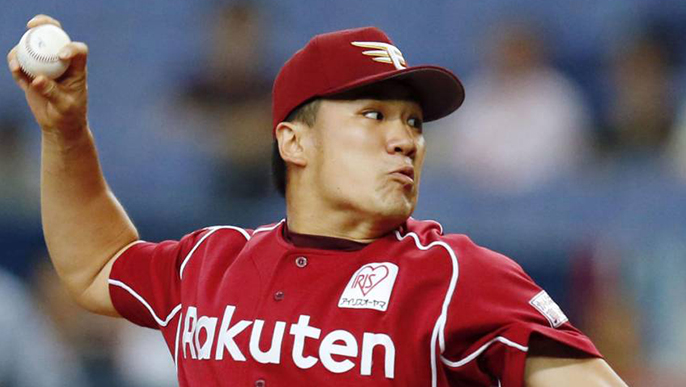
Like many predicted the New York Yankees won the bidding war on Masahiro Tanaka, in part due to the fact that Alex Rodriguez's suspension was upheld. Tanaka will be pitching in New York under a 7 year $155 Million contract that contains an opt out clause after the forth season. Tanaka is 25 and compared to Clayton Kershaw who is also 25 Tanaka was just $60 Million shy of his deal making Tanaka the second largest contract given to a pitcher this off season.

Tanaka, as mentioned earlier is 25 years old and has already pitched 7 complete seasons for the Rakuten Golden Eagles in Japan. He has racked up 1315 innings in those 7 seasons which did concern many clubs, but I don't see it as a concern, I think he will make the transition nicely, just like Yu Darvish.

To compare Tanaka to Darvish, both pitched in the same league, Darvish for the Nippon Ham Fighters, so they have been facing the same players over the past few seasons. Yu Darvish also pitched seven complete seasons before coming to the United States and racked up 1268 Innings, so I do not see the concern with Tanaka pitching just 47 innings more. In his last three seasons Darvish pitched in Japan his ERA was 1.73, 1.78, and 1.44 respectively. He also averaged roughly 200 innings pitched per season those last three seasons. As for Tanaka the last three seasons he pitched his ERA was 1.27, 1.87, and 1.27 respectively. Tanaka averaged roughly 200 innings pitched per season those last three seasons as well.

The difference between Tanaka and Darvish is the fact that Davish has "strikeout stuff," but there is not enough significant evidence to support that claim. In Tanaka's career in Japan he had 8.5 K/9 and Darvish had 8.9 K/9, so they are actually statistically similar. Tanaka does feature a great splitter/slider combination and can reach 94-95 on his fast ball but averages around 91-92. Comparisons for Tanaka come to Hiroki Kuroda.

The Yankees needed pitching rather badly, and now they have four given arms in their rotation. Tanaka will likely take the third slot just to be safe behind Sabathia and Kuroda. The next step for the Yankees in this busy off season would to add to their bullpen and improve on their infield depth.

Friday, April 19, 2013

Think Differently

Baseball is a thinking mans game, but sometimes the thought process doesn't exactly make sense. The traditional way to evaluate players with your eyes is dying out and evaluating players with mathematics is on the rise. I think of the game on its most basic level. The point of baseball is to score more runs than the other team. I always put emphasis on pitching, because you cannot win if you cannot score.

The other day I heard one of the most ridiculous things baseball related in a while regarding Diamond Backs starting pitcher Wade Miley. I don't know where the YES Broadcaster was reading it from, but an article said that for Wade Miley 2012 is as good as it gets. The article emphasis Miley's 17% strikeout rate. The part that got me upset was the fact that the article said Miley's 17% strikeout rate barely cuts it for a starter. I'll explain why this makes no sense. Whether this is true or I'm just hearing things, I'll explain my thinking.

The first point I will make is an obvious one yet no one seems to understand it. We as fans have fallen in love with the strikeout, but for starting pitchers it isn't a necessity and almost always irrelevent. It takes a minimum of three pitches to strikeout a hitter. It takes a minimum of one pitch to get a hitter out in any other way. Remember the point of a starter is to pitch deep into the game and to do it well. The fewer pitches used, the further a pitcher can go before he is fatigued.

The second point I will make is the quantity of outs. A strikeout can only get you one out at a time, while a contact out (i.e. a ground ball) can get you multiple outs, two or possibly even three... on one pitch. Do I need to explain that any further. It's common sense. two or three outs is better than one out.

The third point I will make is regarding hits. I do not care how many hits you give up. Going back to the basic principle of the game, to score more runs than the other team. If the players who get the hits don't score, does it matter? Think about it as long as the pitcher isn't using a lot of pitches and laboring through the game as long as the runs don't score, it doesn't matter how many guys get hits or get on base for that matter. You can give up three singles and then get a pop up, and a ground ball and not allow any runs to score and only use five pitches in the inning. Makes enough sense.

 "Barely cuts it as a starter." These words ticked me off. It is only logical for a reliever to specialize in strikeouts! A bases loaded jam in the 8th inning with zero outs. What do you want? A strikeout. Would you bring in Miley with a 17% strikeout rate or Kimbrel with a 50%+ strikeout rate? In this case contact is bad. Any type of contact is a very high risk of scoring a run. A sac fly, ground ball to a middle infielder, a hit, etc scores a run. So why would Miley barely cut it as a starter if he can't get strikeouts?

Just think of the game on a basic level. We love strikeouts, they are entertaining, but they are not necessary for starters. Pitching to contact is a more efficient and sometimes more effective way of getting outs and going further in the game. I'll make a post about thinking on the basic level for hitters soon enough.

Monday, May 21, 2012

Signing of the Off season

So its about 45 games into the season and the season is about 25% over. There have been a few plays who performed very well so far into the season, but they are all getting paid a lot. Which player is getting underpaid for their performance? A team wants to pay players the minimum amount of money for the maximum efficacy .

The player that is doing the most for the least amount of money in 2012 is Raul Ibanez. Ibanez is 39 years old is going to be 40 later in the year. He is an established veteran and that shows when he comes through in the clutch. Ibanez gets paid 1.1 million dollars for the 2012 season and has great stats for such a little amount of money (compared to other salaries.) In 33 games and 118 plate appearances Ibanez has a .336 on base percentage and a .473 slugging percentage. He has 9 home runs for the season. It may not seem outstanding, but a while ago someone told me "Its not how hard you hit it; its where you hit it." I think for Ibanez its when you hit it. Ibanez seems to always get home runs and rbis when the Yankees are down by a few runs or to add insurance runs.

If you divide it out the Yankees are paying Ibanez $6790 a game and 42 games into the season he earned $285185. That means the Yankees are paying $9199 for a run produced by Raul Ibanez.

Tuesday, May 15, 2012

What's the Average?

So recently I've been expanding my statistic Pitching Performance Value. So whats the average value of a start. The average amount of innings pitched from a starter is 6.0 so that means they recorded 18 outs. Also the average ERA in the major leagues is 3.94. That means over 9 innings a pitcher would give up 3.94 earned runs. That turns out to be 2.63 earned runs over 6 innings. Additionally the average whip for a pitcher is 1.32, so tha means over 6 innings pitched 7.92 base runners will reach base. Finally the average OPS of a hitter is .720. So do a quick calculation the average Pitching Performance Value is 62.22. Anything above 62.22 PPV from a pitcher's start would be above average. If a pitcher consistently gets PPV's above 62.22 he is considerably better than the average pitcher.

Coming soon: A way to adjust PPV for the ballpark the pitcher is in.

Wednesday, January 25, 2012

King Cabrera and Prince Fielder

There is a monarchy taking over at first base in the Motor City. Last night Prince Fielder signed with the Detroit Tigers for 9 year $214 million. After the injury to Victor Martinez, putting him out for most of the 2012 season The Tigers quickly became the mystery team for Prince Fielder.

As a kid Prince Fielder would hit home runs out of old Tigers' Stadium with his dad Cecil Fielder. Fielder will be 28 in June of 2012 and he has already established himself as a power house. He hit 46, 32, and 38 home runs in 2009, 2010 and 2011 respectively. Over those 3 years he gathered 344 RBI's with a 154 OPS+ and a .409 on base percentage. He will provide a lot of offense for the Tigers.

We all know how dangerous Miguel Cabrera is, but lets take a look at his stats. In 2011 Cabrera hit 30 home runs, 108 RBI's, had a .448 on base percentage and a 181 OPS+, which is ridiculous.  The 3-4 Spots in the line up will be a RBI factory for the Tigers.

The road trips to the AL east will be very offensive, with Fielder and Cabrera playing in Yankee Stadium, Fenway Park, and Camden Yards the baseballs may be flying with the birds.

Sunday, January 22, 2012

Hayes Craze Statistics

This post is just a summation of the statistics I have already developed.

Run Production Probability (RPP) = (Runs + RBI's - Home Runs)
                                                            Total Plate Apearences

Relief Pitcher's Clutch (RPC) = (Strikeouts / Runs)
                                                          WHIP

Lead Off Value (LOV) =
(On Base Percentage X (Pitches per Plate Apperence))(Stolen Bases^2/Caught Stealing)
                                             Time to Run 90 Feet

There is a statistic coming tomorrow so be ready to get the Hayes Craze in you. I know that was corny.

Tuesday, January 10, 2012

Relief Pitcher's Clutch

We all know those really tough situations in the ball game. Bases loaded, no outs, and the opponents slugger is at bat. Who do you want to get you out of this jam? The guy in your bullpen with the most clutch. Up to now there hasn't been a reliable statistic to measure a pitchers clutch to my knowledge. Well I have developed one. I call this statistic RPC standing for Relief Pitcher's Clutch.

If your in a tough part of a game, you want a strike out, this is what relief pitchers are inevitably known for. In this statistic strikeouts will work at a pitchers advantage. Runs and an elevated whip (walks and hits per innings pitcher) will work at the pitcher's disadvantage. In an important game where the score is close and there are runners on base, you do not want runs to score, nor do you want to add additional runners on base.

To explain why the strikeout is important. If you get a strikeout you are obviously not getting a different kind of out, ground out, fly out, pop out etc. A 'contact out' may result in a run scoring and there is always a chance of the fielder dropping it or committing an error. This is why strikeouts would work at the relief pitcher's advantage in the statistic.

Finally to reveal the statistic: RPC = (Strikeouts / Runs) / (Walks and hits per innings pitched)
                                           RPC = (K/R) / (Whip)
                                           * The higher the number the better the pitcher's clutch

Now you check the math. What if the Runs or Whip is equal to 0. In the case of Runs be 0 the RPC is infinity. In the statistic for earned run average, if a pitcher gives up a run with 0 innings pitched, his ERA would be INF.  Getting back to RPC, if a pitcher's RPC is infinity he is currently 100% clutch, because he has not allowed a run to score. If the whip is 0 the player currently doesn't qualify for the statistic, because he could have given up a run without giving up a hit. If Both Whip and Runs are 0 then the RPC is infinity.

To look at some examples. David Robertson is notorious for getting out of big jams. He has 100 strikeouts, 9 runs, and a 1.125 whip. This gives him a 9.88 RPC. among the highest for 2011, earning him the name Houdini.

Dennis Eckersley's 1990 season 73 strikeouts, 9 runs, and a 0.614 whip giving him a  13.21 RPC, one of the best all time.

Now you may say RPC is directly proportional to ERA. Not always. Tyler Clippard of the Washington Nationals, and Mariano Rivera of the New York Yankees have very similar ERA's 1.83 and 1.91, respectively. That is just a 0.08 point difference, barely anything, or noticeable, but Clippard's high amount of strikeouts (104) makes him much more clutch. Clippards RPC is 6.89 and Rivera's is 5.14. Rivera gets more of his outs from contact, making him less clutch in a tough situation.

I believe that the clutch rating may be the end of the closer, because if you have bases loaded jam with none out in the 7th inning, wouldn't you want your best pitcher to be in the game then and not close the door with the bases empty, just cruising by.